7 Procore Alternatives for Small and Mid-Sized Contractors in 2026
Disclosure: This article contains affiliate links. If you sign up through them, StackVett may earn a commission at no extra cost to you. Our reviews and rankings are not influenced by these partnerships — see our full Affiliate Disclosure for details.

Why Procore’s Pricing Model Works Against You
You asked for a price. They asked about your annual revenue instead. That single exchange tells you more about whether Procore fits your business than any demo ever will.
Procore’s pricing is based on your Annual Construction Volume, meaning your software cost scales with your revenue. Most contractors at mid-size volume end up paying somewhere between $10,000 and $60,000 or more per year.
Contractors across review platforms consistently report renewal increases of 5 to 14 percent annually, meaning the bill gets heavier every year.
For a company billing $2 million to $5 million, that math is hard to justify when half the platform targets commercial work you do not run.
Complexity drives many contractors away too. Getting Procore fully operational typically takes months and often requires someone dedicated to managing the rollout.
If you need a platform your foreman can learn in an afternoon and your project manager will actually open by next week, Procore’s depth creates friction before it creates value.
The fit problem is the third issue. Procore targets large commercial general contractors managing hundreds of drawings, complex RFI chains, and major financial workflows.
Residential builders, remodelers, and smaller GCs end up paying enterprise rates for features they rarely touch.
There is nothing wrong with the platform for the audience it serves. It just was not designed for your size of operation.
The alternatives below all address one or more of those problems. Several publish pricing openly so you never have to talk to a salesperson just to find out what you would pay.
A few offer real trials before you spend anything. Some can have your team running live jobs within days of signing up.
This article covers platforms where this site earns a commission and some where it does not. Rankings reflect use case fit, published pricing, and verified contractor ratings rather than commission rates.
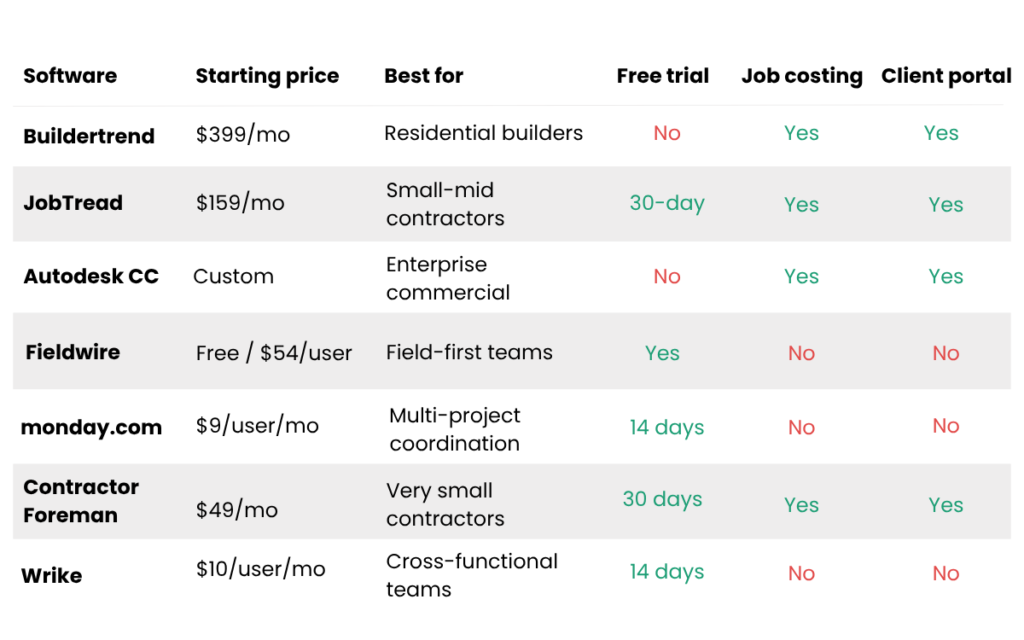
7 Procore Alternatives comparison
⚡ Quick Recommendation
If you want one platform to compare first, start with JobTread
For small to mid-sized contractors leaving Procore over pricing or complexity, JobTread consistently scores highest on G2 (4.9 to 5.0 out of 5), publishes its rates openly ($159/month annual or $199/month monthly), and gets most teams operational within days. If you’d rather narrow down all seven options based on your specific priorities, our free Excel comparison tool scores them across 9 criteria in 5 minutes.
Try JobTread → Get Comparison Tool →The 7 Alternatives Worth Evaluating
1. Buildertrend
Buildertrend is the most purpose-built Procore alternative for residential and remodeling work. The platform covers project management, scheduling, client communication, selections, and financials in one place.
The homeowner client portal is the standout feature for contractors billing directly to owners and homebuilders.
Scheduling tools are visual and easy to update without training. The mobile app works reliably from the job site, and onboarding takes days rather than months.
Pricing on the annual plan starts at $339 per month for the Essential tier. Advanced runs $499 per month and Complete runs $829 per month.
Every tier includes unlimited users. No free trial is available, which means you commit financially before testing the platform in a live environment.
That point is worth sitting with. If you have bought software before and abandoned it within a month, committing without a trial is a real risk.
Buildertrend earns strong reviews from residential contractors who stay with it. Getting your foreman to actually adopt something new is a different challenge, and you are betting on that adoption before you see it happen.
Buildertrend consistently outperforms Procore for residential contractors in several ways.
- Homeowner portal rated best-in-class for client communication across residential contractor reviews
- Visual scheduling built for how residential projects actually flow
- Onboarding measured in days, not months
- Unlimited users at every plan level
Large commercial projects with heavy drawing management and layered RFI workflows fall outside what Buildertrend does best.
Unlike most direct competitors, Buildertrend offers no way to test the platform before you commit.
Best fit: residential builders, custom home contractors, remodelers, and small commercial contractors who prioritize client experience and ease of use.
Buildertrend currently offers 10% off annual plans. If the residential focus and client portal fit your operation, this is the best time to lock in pricing.
Get a Buildertrend Quote → Read full review →2. JobTread
JobTread has emerged as one of the strongest Procore alternatives for small to mid-sized contractors who want serious construction tools without the enterprise price tag.
JobTread’s G2 rating sits between 4.9 and 5.0 out of 5 across verified contractor reviews, placing it among the highest-rated platforms in the construction software category.
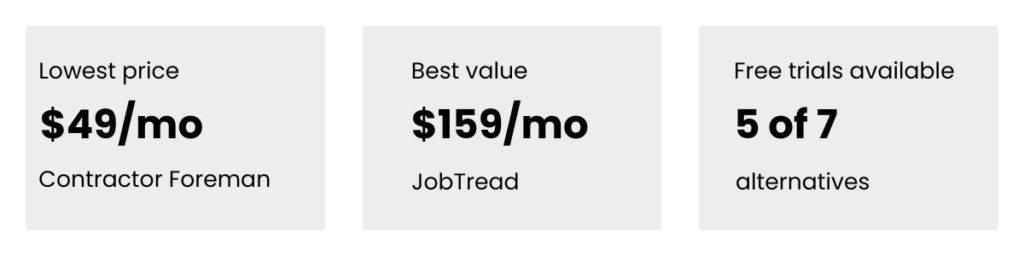
Pricing is published openly without a form to fill out or a salesperson to call. The annual plan starts at $159 per month for the first internal user, with each additional internal user at $18 per month.
Field crew who only need to log daily notes, upload photos, or check their schedule can be added as free users.
The monthly plan costs $199 per month for the first user and carries no annual commitment. A 30-day money-back guarantee applies to the monthly plan.
One thing contractors consistently mention is how fast the onboarding goes. Many report being fully operational within a few days of signing up.
Every subscription includes free unlimited implementation support, onboarding training, and US-based customer service.
That matters when your alternative was a months-long Procore rollout that required outside help to manage.
A few details are worth knowing before you sign up.
- JobTread includes all features at one plan level with no gated upgrades or tier pressure
- Accounting integration is QuickBooks-only, so contractors running Sage or Xero should note this
- A team of 5 paying users on the annual plan costs around $231 per month total
- Subcontractors, vendors, and clients access external portals at no charge
The mobile app handles job site access well, and field crew with limited access needs can be added for free, which keeps the per-user cost manageable on jobs where not everyone needs full functionality.
Best fit: residential contractors, remodelers, and small to mid-sized general contractors who want full-featured construction management with published pricing, fast onboarding, and no enterprise overhead.
JobTread is the StackVett affiliate pick for small-to-mid contractors
Highest-rated platform among small contractors on G2. Published pricing, all features included, fast onboarding, and free implementation support. We’ve negotiated an exclusive bonus package for readers who sign up through our link — three implementation tools worth $2,000 to $5,000 in consulting fees, free.
Try JobTread → Read full review →3. Autodesk Construction Cloud
Autodesk Construction Cloud is the most credible enterprise Procore competitor.
Its primary product, Autodesk Build, combines the capabilities of the former PlanGrid and BIM 360 platforms.
The result covers field management, document control, RFIs, submittals, and cost management across the full project lifecycle.
For contractors already running Autodesk design tools like Revit and AutoCAD, the workflow integration is clean and hard to match.
Pricing requires a custom quote. Implementation carries complexity similar to Procore’s rollout, so this is not a budget play or a platform you go live on in a week.
If you run residential builds or smaller commercial work and found Procore too complex and too expensive, this platform will not solve those problems.
It belongs on this list for large GCs and construction managers on BIM-heavy commercial projects who want Procore’s depth under a different pricing model.
Best fit: large commercial contractors, construction managers, and enterprise firms with existing Autodesk design workflows.
4. Fieldwire
Fieldwire is a field coordination platform built around what happens on the job site. Plan management, task coordination, punch lists, and inspection tools are the core product.
Field crews consistently praise the mobile app for its reliability, and it works offline, which matters on sites where connectivity is unreliable.
Workers can view drawings, annotate plans, and log progress without waiting for a signal.
A free plan covers up to 5 users and 3 active projects. Paid plans start at $39 per user per month for the Pro tier on annual billing, which removes the project and sheet limits. The Business plan, which adds integrations and custom forms, costs $64 per user per month on annual billing.
Fieldwire does not replace Procore’s financial management, estimating, or client communication tools.
Many teams pair it with a separate accounting system rather than using it as a standalone platform.
For reliable field coordination your crew will actually open and use on site, it does that better than most.
Best fit: specialty subcontractors, field-first teams, and project managers who need dependable on-site coordination without enterprise complexity.
5. monday.com
monday.com sits outside the construction software category entirely, and that is worth knowing upfront.
Construction companies managing multiple simultaneous job sites who need a central coordination hub, and who already have separate tools for estimating and accounting, consistently find genuine value in it.
For pricing, features, and where it actually falls short for contractors, see our full monday.com construction review.
Its main advantages over Procore for that specific use case are transparent pricing, a genuine free trial, and fast setup.
The Basic plan starts at $9 per user per month on annual billing, with a 3-seat minimum. A 14-day free trial lets your team test the real interface before spending anything.
Setup takes hours rather than weeks, and the automation engine reduces a surprising amount of manual status chasing across multi-project operations.
There is no purpose-built estimating, no job costing, and no homeowner client portal. If you need a true Procore replacement that handles the full construction workflow, monday.com is not the answer.
For contractors whose main problem is coordinating across active job sites and who already handle accounting separately, it earns its place in that role.
Best fit: mid-sized construction companies that need a flexible coordination hub for multi-project management and already have separate estimating and accounting tools.
6. Contractor Foreman
Contractor Foreman pricing starts at $49 per month for unlimited users – the most affordable all-in-one construction management option available.
The platform includes project management, scheduling, daily logs, estimates, change orders, invoicing, and time tracking. For the price, the feature coverage is genuinely hard to match.
All plans come with a 30-day free trial. Annual plans on the Plus, Pro, and Unlimited tiers carry a 100-day money-back guarantee.
That removes the financial risk of committing to the year before you are certain it works for your crew.
The tradeoffs are real. Polish and financial management depth fall below what you get from Buildertrend or JobTread.
Estimating workflows feel more limited for complex projects, and some modules need more customization than higher-priced alternatives provide out of the box.
For very small contractors and owner-operators who need essential project management without significant monthly overhead, the value holds up. No other platform in this category comes close on price.
Best fit: very small contractors and owner-operators who need essential construction management tools at the lowest possible monthly cost.
7. Wrike
Wrike is a general project management platform starting at $10 per user per month with a 14-day free trial. It has no construction-specific features, no job costing, and no field management tools.
Larger construction companies sometimes add it as a coordination layer when they already have separate construction and accounting software in place.
For small and mid-sized contractors shopping for a Procore replacement, Wrike is unlikely to fit.
Some construction organizations use it for cross-departmental coordination alongside existing tools, which is the only context where it belongs on a list like this.
Best fit: large construction companies managing cross-departmental workflows that already have dedicated field and accounting tools in place.
How They Compare Side by Side
| Platform | Starting Price | Best For | Free Trial |
|---|---|---|---|
| Procore | Custom quote (~$10k-$60k+/yr, ACV-based) | Large commercial GCs | No |
| Buildertrend | $339/month | Residential builders | No |
| JobTreadOur pick | $159/month | Small to mid contractors | 30-day guarantee |
| Autodesk Construction Cloud | Custom quote | Enterprise commercial | No |
| Fieldwire | Free / $39/user/month | Field-first teams | Yes |
| monday.com | $9/user/month | Multi-project coordination | 14 days |
| Contractor Foreman | $49/month | Very small contractors | 30 days |
| Wrike | $10/user/month | Cross-functional teams | 14 days |
Procore does not publish pricing; it bills annually based on Annual Construction Volume (ACV), so the figure shown is a typical reported range rather than a fixed rate. Pricing last checked August 2026 – confirm current rates with each vendor.
Seven options is a lot. If you want a structured way to narrow them down based on what actually matters to your business, I built a free Excel comparison tool that scores Procore, Buildertrend, JobTread, monday.com, and Contractor Foreman against your specific priorities. Takes about 5 minutes to fill out, gives you a personalized ranking before you commit to anything.
How to Match the Right Tool to Your Situation
💡 Start by knowing your margin
Before matching a platform to your situation, run your current job costs through our construction markup calculator. The gap between your applied markup and your actual margin tells you which price tier – from $49/month to $30,000+/year – your business can realistically absorb. Without that number, every matching criterion below is a guess.
When Price Is the Main Reason You Avoided Procore
JobTread at $159 per month gives the best value for a small team with all features included from day one.
A 5-person team on the annual plan comes out around $231 per month total.
Contractor Foreman at $49 per month is the lowest entry point if you need essentials without deep financial management.
When Complexity and Setup Time Drove You Away
JobTread and Buildertrend both measure onboarding in days rather than months.
Free implementation support comes with every JobTread plan, which removes the learning curve that kills adoption on new software.
monday.com’s 14-day trial lets your team test the actual interface before you commit anything.
When You Run Residential Construction
Buildertrend is the purpose-built choice with the strongest homeowner communication portal in the category.
JobTread is the stronger value if pricing is a real constraint and you need tight job costing alongside project management.
When You Need Field Tools Your Crew Will Actually Use on Site
Fieldwire is the right answer for plan management and on-site task coordination, with an offline-capable mobile app your crew can use without waiting for a signal.
Pair it with a separate accounting tool if you need invoicing and job costing alongside it.
When Your Team Is Small and Your Budget Is Tight
Contractor Foreman’s 30-day free trial lets you test the full platform before spending anything.
JobTread’s 30-day money-back guarantee on the monthly plan provides the same protection. Neither forces you to commit before you are confident.
When You Need Enterprise Depth Without Procore’s Pricing Model
Autodesk Construction Cloud is the strongest alternative at that level, particularly for BIM-heavy commercial work.
What Contractors Ask Before They Switch
What is the cheapest alternative to Procore?
Contractor Foreman starts at $49 per month with unlimited users and a 30-day free trial. JobTread starts at $159 per month with all features included.
Both cost a fraction of what most contractors pay for Procore on an annual basis.
Is there a Procore alternative with a free trial?
Several are available. Fieldwire has a free plan for teams of up to 5 users across up to 3 projects. monday.com offers a 14-day trial. Contractor Foreman gives you 30 days.
JobTread’s monthly plan carries a 30-day money-back guarantee, which removes the financial risk of testing the platform before you commit to the year.
What do most small contractors use instead of Procore?
The most commonly used alternatives for small contractors are JobTread, Buildertrend, Contractor Foreman, and Fieldwire.
JobTread is currently the highest-rated option among small contractors on G2. Buildertrend remains the dominant choice for residential builders and remodelers specifically.
Is Buildertrend better than Procore for residential work?
For most residential contractors, yes. Buildertrend costs less, sets up faster, and centers on homeowner-facing workflows.
Its client portal and scheduling tools target residential construction specifically in ways that Procore, which focuses on large commercial work, does not match.
The tradeoff is that Buildertrend offers no free trial and requires a financial commitment before you see whether your team will actually adopt it.
How long does it take to set up JobTread?
Most contractors report being fully operational within a few days of signing up. Every plan includes free implementation support and onboarding training.
This stands in sharp contrast to Procore’s typical implementation timeline, which runs several months and often requires outside support to manage.
Does monday.com actually work for construction?
It works well for a specific use case. Coordinating multiple projects, managing schedules across teams, and reducing manual status chasing are all areas where it adds genuine value without construction-specific features.
It does not replace purpose-built tools for estimating, job costing, or client communication.
Contractors who already handle those pieces separately and need a coordination hub will find it fits well. A complete Procore replacement, it is not.
Disclosure: This article contains affiliate links. If you purchase software through our links, we may earn a commission at no additional cost to you. This does not influence our reviews or recommendations.