Contractor Foreman Pricing & Review (2026): Honest Take for Small Contractors
Disclosure: This article contains affiliate links. If you sign up through them, StackVett may earn a commission at no extra cost to you. Our reviews and rankings are not influenced by these partnerships – see our full Affiliate Disclosure for details.

| Contractor Foreman | |
| Starting price | $49/mo |
| Free trial | 30 days, all plans |
| Price guarantee | Rate locked for life |
| Job costing | Yes |
| Client portal | Yes |
| Best for | Small contractors under $5M ACV |
| G2 rating | 4.5/5 (800+ reviews) |
If Procore’s pricing model has ever felt like a penalty for landing good work, you have spotted the real problem.
Procore charges based on your Annual Construction Volume, which means every strong year triggers a larger bill at renewal. For a contractor doing $1M to $5M, that dynamic caps what you can realistically spend on software.
Contractor Foreman pricing starts at $49 per month and locks in that rate on the day you sign up.
At that price, it costs less than what most project management tools charge for a single user.
This review covers what the platform actually delivers, where it has real gaps, and whether it makes sense for a small to mid-size contracting operation in 2026.
⚡ Quick Recommendation
Contractor Foreman is the lowest-risk way to test construction software
Starting at $49/month for the entire company (not per user), with the longest free trial in the category at 30 days and no credit card required. Annual plans on Plus, Pro, and Unlimited tiers add a 100-day money-back guarantee. Free training and a dedicated Customer Success Manager are included on every plan. If you’re a small contractor under $5M ACV currently running on spreadsheets, this is the most rational first step.
Start 30-Day Free Trial → Compare Alternatives →No credit card required. Free training included. 100-day money-back guarantee on annual Plus, Pro, and Unlimited plans (terms apply).
What Contractor Foreman Is and Who It’s Built For
Contractor Foreman is a cloud-based construction management platform built for contractors running under roughly $10M in annual volume.
The system covers project management, scheduling, job costing, time tracking, estimates, change orders, client communication, and safety compliance.
You can access it from your phone, tablet, or desktop.
People with real construction backgrounds built the platform, and the layout reflects that. Rather than borrowing generic task management logic from office software, it mirrors how contractors actually think about running jobs.
Picture a five-person remodeling crew managing three active jobs. The owner is tracking schedules in a spreadsheet, texting crew members for timesheet updates, and fielding client calls for status reports.
Contractor Foreman replaces all of that with one system where crew members clock in via GPS, clients check progress through a dedicated portal, and the owner sees real-time job cost without chasing anyone down.
The platform is not trying to scale up to enterprise commercial work. Its focus is on giving small contractors a professional, organized operating setup that was previously only practical for much larger operations with bigger software budgets.
Contractor Foreman is the right fit if you are:
- A solo contractor or small team doing under $5M ACV
- Currently managing jobs with spreadsheets or disconnected tools
- Looking for Procore-level coverage without Procore-level pricing
- A general contractor, remodeler, or trade contractor
- A contractor who needs GPS time tracking and built-in safety compliance
It is probably not the right fit if you are:
- A large commercial GC doing $30M or more in annual volume
- Running complex multi-phase projects that require advanced estimating
- Looking for enterprise-grade financial controls
Pricing and the Price Lock Guarantee
The price lock is the feature that separates Contractor Foreman most sharply from competitors. Buildertrend started at $99 to $199 per month back in 2018 and 2019.
Contractors who signed up at those rates now report paying three to five times that amount for the same core features. Documented price hikes in 2022 alone ran 50 to 65 percent for many long-time users.
Procore’s costs compound differently, but the direction is the same. Your bill grows as your business does.
Contractor Foreman’s stated policy is that your rate never changes after signup. That makes the $49 starting price more valuable than it looks on paper. You are not just buying software access today.
Signing up locks in your operating cost for as long as you stay on the platform.
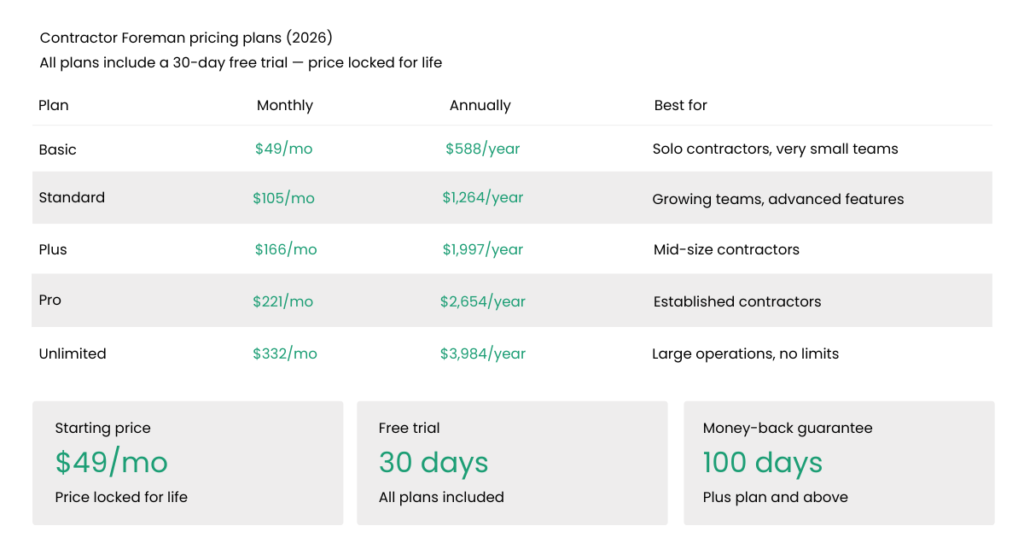
All plans come with a 30-day free trial and no credit card required. Plus, Pro, and Unlimited plans include a 100-day money-back guarantee.
That window is long enough to run several real projects through the system before you commit fully.
Most contractors under $5M will find the Basic plan covers the daily essentials. The Standard plan at $105 per month adds work orders, permits, online payments, and purchase orders, making it the better fit for teams running several active jobs at once.
Prices for the Plus, Pro, and Unlimited tiers are approximate, so confirm exact current figures on the Contractor Foreman pricing page before signing up.
The Features That Matter Most for Small Contractors
Project Management and Scheduling
The interface covers the full project cycle from initial estimate through scheduling, daily logs, change orders, and closeout. It includes Gantt charts, calendar views, and task assignments.
Most contractors report being operational within a day or two of setup, which matters when you do not have IT support or a dedicated onboarding budget.
If you are switching from spreadsheets, Contractor Foreman lets you import existing cost item lists and contact information, so you are not starting from scratch.
Customer support runs through live agents, and user reviews consistently note that response times are fast.
For a small operation without in-house tech help, that matters when something breaks in your workflow on a busy day.
Job Costing
For a contractor trying to understand where money is going on each job, real-time job costing delivers immediate practical value.
You can track estimated versus actual costs as a project progresses, rather than discovering at closeout that materials ran over.
Invoices, change orders, and purchase orders feed into the same view, keeping the financial picture current without manual reconciliation.
💡 First, understand the margin you’re working with
Before committing to any job costing software, see what your margin looks like today. Our construction markup calculator reveals the gap between the markup you applied and the actual margin you’re left with — a number most spreadsheet-era contractors discover is smaller than they assumed. That baseline tells you whether Contractor Foreman’s $49/month is solving a real problem worth solving.
GPS Time Tracking and Crew Management
The GPS timecard feature lets crew members clock in and out from their phones, with location data attached to each entry.
For contractors managing field crews across multiple sites, this removes the daily friction of paper timesheets. Instead of chasing down hours at the end of every week, you get accurate clock data with job site location attached automatically.
Crew scheduling connects to the same module, so you can see who is assigned where and make adjustments in real time.
Safety Compliance
Every plan level comes with a built-in library of over 800 safety meeting topics. This is not something most competitors offer at any price, let alone at $49 per month.
For contractors who need to document safety meetings for insurance or compliance purposes, having that library available out of the box removes a recurring administrative burden.
Client Portal
Clients log into a dedicated portal to view project progress, approve change orders, and communicate directly with your team.
Procore and Buildertrend both include client portal access, but reaching that functionality on either platform costs significantly more than Contractor Foreman’s entry price.
For small contractors, having a professional client-facing portal at the Basic plan level raises the standard of what you can offer. That visibility used to require a much bigger software budget.
Integrations
Contractor Foreman connects with QuickBooks Online on all plans, which is the integration most small contractors prioritize.
Additional connections include Google Calendar, Outlook 365, Zapier, and CompanyCam. The Zapier link opens up a wide range of automation options without requiring any custom development work.
What It Does Well and Where It Falls Short
Pros
- Plans start at $49/month with no per-user fees on most tiers
- Rate locks in at signup and never increases
- 30-day free trial on all plans, no credit card required
- 100-day money-back guarantee on Plus and above
- Real-time job costing at every plan level
- GPS time tracking included without an add-on fee
- 800+ safety meeting topics built in at no extra cost
- Client portal accessible from the Basic plan
- Strong QuickBooks Online integration on all plans
- Recognized by Forbes Advisor as Easiest to Use and by BobVila as Best Overall
Cons
- Some modules feel less polished than Procore or Buildertrend at equivalent feature depth
- Estimating slows down with large cost databases
- Occasional app loading delays reported by field users
- Mobile offline functionality is limited, creating friction on sites with poor signal
- Interface updates sometimes shift navigation in ways that take adjustment
- Not well-suited to large commercial GCs or operations with enterprise accounting requirements
Before you commit to any platform, it pays to see how it stacks up against the alternatives. I built a free Excel comparison tool that scores Procore, Buildertrend, JobTread, monday.com, and Contractor Foreman against your specific business priorities. Takes about 5 minutes to fill out, gives you a personalized ranking.
How It Compares to the Main Alternatives
| Contractor Foreman | Procore | Buildertrend | JobTread | |
| Starting price | $49/mo | $375+/mo | $339/mo (annual) | $159/mo (annual) |
| Free trial | 30 days | No | No | Money-back guarantee |
| Price guarantee | Yes | No | No | No |
| Job costing | Yes | Yes | Yes | Yes |
| Client portal | Yes | Yes | Yes | Yes |
| Best for | Small contractors | Large commercial | Residential | Small to mid |
The comparison table captures the headline numbers but leaves out important context.
Procore’s $375+ figure is an estimated starting point because Procore does not publish pricing publicly.
Its actual cost depends on your Annual Construction Volume and the specific modules you select. For a $5M contractor, it can run well into five figures annually.
Buildertrend’s $339 reflects the Essential plan on annual billing. Monthly billing starts at $499, and the Advanced plan runs $499 to $799 per month depending on billing cycle.
JobTread‘s $159 is the annual billing rate for the first user, with each additional internal user costing $18 per month on an annual plan.
The money-back guarantee listed for JobTread applies to monthly subscriptions and is not a free trial in the traditional sense.
Is Contractor Foreman Worth It for a $1M to $5M Contractor?
For a small contractor currently running on spreadsheets, Contractor Foreman is almost certainly worth the 30-day trial. No credit card is required, and testing it against real active projects costs nothing.
The platform works best for contractors in the $1M to $5M range who need centralized project management, time tracking, job costing, and client communication.
If Procore’s price or complexity has kept you on spreadsheets, this is the practical next step.
A few limitations are worth knowing before you commit. The estimating workflow slows down with large cost databases. Some modules lack the depth that larger commercial operations need.
If you are running complex multi-phase commercial projects or need enterprise-grade financial controls, Contractor Foreman will likely feel like a ceiling at some point.
For a contractor in that target range, Contractor Foreman covers the daily operational basics at a price the business can absorb.
The rate-lock guarantee and the free trial make it the most rational first step for small contractors moving off spreadsheets.
We rate Contractor Foreman 4.3 out of 5. It is the strongest value-for-money construction management platform available for contractors under $5M ACV.
Ready to test it on real projects? The 30-day free trial requires no credit card and includes free training plus a dedicated Customer Success Manager. By day 30, you’ll know whether Contractor Foreman fits your operation — and the rate locks in for life on signup.
Start Your 30-Day Trial →If You Need More Polished Workflows
JobTread covers the same residential and small-to-mid market with deeper financial features
Contractor Foreman is the strongest value pick under $5M ACV. If your operation has outgrown spreadsheets but you also want more polished estimating, deeper job costing, and a more refined interface, JobTread fits a step above — at $159/month annual or $199/month monthly with a 30-day money-back guarantee. Different fit, different trade-offs, but worth comparing if Contractor Foreman starts feeling like a ceiling.
Read the JobTread Review →⚡ IF YOU COMPETE ON DESIGN, NOT JUST PRICE
Houzz Pro adds marketplace lead-gen and 3D design tools at $149/month
Contractor Foreman wins on price and rate-lock stability. If you’re a design-build firm, residential designer, or kitchen and bath remodeler who wins jobs through visual presentation rather than the lowest bid, Houzz Pro brings marketplace access to 65 million monthly homeowners and industry-leading 3D rendering tools — at $149/month. Different value proposition than Contractor Foreman’s $49 budget pick, but worth comparing if design quality is your competitive edge.
Frequently Asked Questions
Does Contractor Foreman offer a free trial?
Yes. All plans include a 30-day free trial with no credit card required.
Does Contractor Foreman raise prices after you sign up?
No. The stated policy locks in your rate on the day you sign up. Your price does not increase based on revenue, project volume, or future pricing changes.
Is Contractor Foreman a good fit for residential remodelers?
Yes. Scheduling, client portals, change orders, and estimates cover most of what residential remodelers handle day to day. The client portal is particularly useful for keeping homeowner clients informed without constant phone calls.
How does Contractor Foreman compare to Procore for a small GC?
Contractor Foreman starts at $49 per month versus Procore’s estimated starting price of $375 or more. Procore’s pricing scales with Annual Construction Volume, making it increasingly expensive as your business grows.
For a contractor under $5M, the cost difference is hard to justify unless you are doing complex commercial work that genuinely requires Procore’s specific capabilities.
Contractor Foreman covers the core project management, job costing, and communication needs of most small GCs at a fraction of that cost.
Does Contractor Foreman work with QuickBooks?
Yes. QuickBooks Online integration is available on all plans.
Which plan do most small contractors need?
Most contractors under $5M start on the Basic plan at $49 per month to test the system. They typically move to Standard at $105 per month when they need work orders, online payments, and purchase orders.
The Basic plan covers project management, scheduling, time tracking, job costing, and the client portal for smaller operations.
Disclosure: This article contains affiliate links. If you purchase software through our links, we may earn a commission at no additional cost to you. This does not influence our reviews or recommendations.